Chapter 2: Medieval Europe and the Birth of the University
“The medieval university did not emerge in an intellectual vacuum. It grew from centuries of teaching, textual scholarship, religious learning, professional training, urban development, and organized communities of masters and students.”
The modern university is so familiar that it is easy to imagine that universities have always existed. They have not. The university, as an institution with recognizable corporate identity, faculties, masters, students, degrees, examinations, academic privileges, and systems of authorization, emerged gradually in medieval Europe.
Its emergence represents one of the most consequential developments in the history of human learning.
The university created a new institutional environment in which advanced knowledge could be preserved, taught, debated, examined, certified, and transmitted across generations. It also created a structure within which intellectual communities could organize themselves and acquire a degree of corporate independence.
Yet the medieval university should not be understood as a sudden invention. It emerged from earlier traditions: cathedral schools, monastic learning, Roman and canon law, philosophical schools, Islamic and Jewish intellectual traditions, urban schools, professional associations, and the revival of learning in western Europe during the eleventh and twelfth centuries (Verger, 1992; Rashdall, 1936).
By the thirteenth century, institutions such as Bologna, Paris, Oxford, Cambridge, and Salamanca had become major centers of advanced learning. They differed considerably from one another, but collectively they established many of the structures that still characterize higher education.
The medieval university gave institutional form to an ancient aspiration:
the disciplined pursuit and transmission of knowledge.
1. Europe Before the University
Before universities emerged, advanced learning in Latin Christian Europe was concentrated in several types of institution.
Monasteries preserved manuscripts and trained religious personnel.
Cathedral schools educated clergy and provided instruction in grammar, rhetoric, logic, scripture, and related subjects.
Court schools served rulers and administrative elites.
Specialized centers developed around particular fields, especially law and medicine.
Private masters taught students in cities.
The intellectual environment was therefore already active.
The university developed partly because the existing arrangements were no longer sufficient to meet the expanding demand for advanced learning.
The twelfth century witnessed substantial intellectual change. The growth of towns, expanding commerce, administrative development, increased use of written law, and the recovery and translation of important Greek, Roman, Arabic, and Jewish intellectual works contributed to an environment in which advanced education became increasingly valuable (Verger, 1992; Abulafia & Verger, 1999).
Cambridge's history of the medieval university notes that the twelfth-century expansion of schools reflected growing demand for educated people and the expanding range of scholarly culture.
This was the environment from which the university emerged.
2. What Was a Medieval University?
The word university can be misleading when applied to medieval institutions.
A modern university is generally understood as a large institution containing multiple faculties, departments, administrative divisions, libraries, laboratories, professional schools, student services, research centers, and often thousands of students.
A medieval university was much smaller.
More importantly, it was not originally defined primarily by buildings.
The medieval university was fundamentally a community.
The Latin word universitas referred to a corporation, association, or organized body. In the university context, it could refer to the corporate body of masters or students rather than to a physical campus in the modern sense (Rashdall, 1936; Verger, 1992).
This distinction is fundamental.
The medieval university began as an association of people.
The institution came before the campus.
This helps explain why medieval universities could function even without the large purpose-built campuses that characterize modern higher education.
At Cambridge, for example, early teaching took place in parish churches, religious premises, and private houses. Purpose-built university buildings developed later.
3. The Meaning of Universitas
The Latin term universitas is one of the most important words in the history of higher education.
It did not originally mean "university" in the modern sense of a comprehensive institution of higher learning.
It meant something closer to a corporate association or organized body.
A universitas could therefore refer to a legally recognized community with collective rights and responsibilities.
This meaning helps explain the organizational development of medieval universities.
Students and masters needed collective representation because they were interacting with:
- city governments;
- bishops;
- landlords;
- merchants;
- ecclesiastical authorities;
- kings;
- and other political institutions.
A single student had little bargaining power.
A corporation of students could negotiate.
A single master could be vulnerable.
A corporate body of masters could defend professional interests.
Thus, university organization was partly an educational development and partly a development in medieval corporate society.
4. The University as a Guild
One of the most important ways to understand the medieval university is through the analogy of the guild.
Medieval European towns contained numerous associations of craftsmen and merchants.
A guild could regulate:
- entry into a profession;
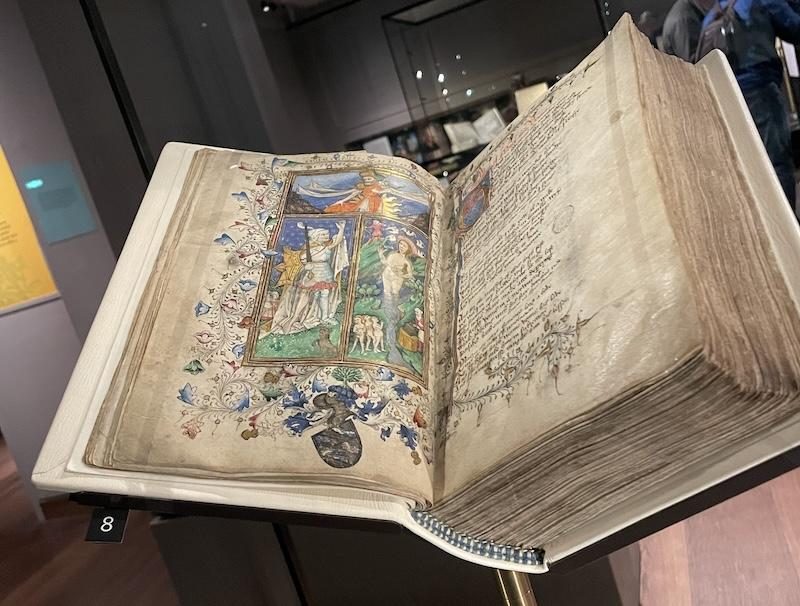
- standards of practice;
- apprenticeship;
- professional privileges;
- relationships between masters and learners;
- and collective economic interests.
The university developed some analogous characteristics.
Masters and students formed organized communities.
There were rules concerning teaching.
There were recognized stages of progression.
There were examinations.
There were professional privileges.
There were mechanisms for admitting new members.
The comparison should not be taken too literally, because universities had distinctive intellectual and legal characteristics. Nevertheless, the guild model helps explain the institutional language of medieval education.
The university can therefore be understood partly as a guild of knowledge.
5. Apprenticeship and Academic Formation
The relationship between apprenticeship and university education is especially important for the history of mastery.
In a craft guild, an apprentice learned under a master.
The apprentice developed competence through observation, practice, correction, and increasing responsibility.
Medieval university education followed a different intellectual model but retained the principle of progressive formation.
The student began with foundational studies.
The student progressed through increasingly difficult material.
The student participated in academic exercises.
The student underwent examinations.
Eventually, the student could become a master.
At this point, education and professional identity converged.
The medieval academic master was therefore not simply someone who had completed a course.
The master was someone authorized to teach.
This connection between qualification and teaching became fundamental to the European academic tradition.
6. The Magister
The word magister is central to the history of mastery.
The Latin magister means master, teacher, or one who possesses authority or expertise in a particular field.
In medieval universities, a magister could be an advanced scholar who had achieved the qualifications necessary to teach.
The term is historically significant because it connects the modern idea of the academic "master" with older traditions of professional mastery.
A master was not merely someone who knew something.
The master possessed recognized competence within an organized intellectual community.
The master could teach.
The master could examine.
The master could participate in academic governance.
The master could help determine whether another student was ready to progress.
Thus:
Mastery was both intellectual and institutional.
7. Bologna: The University of Students
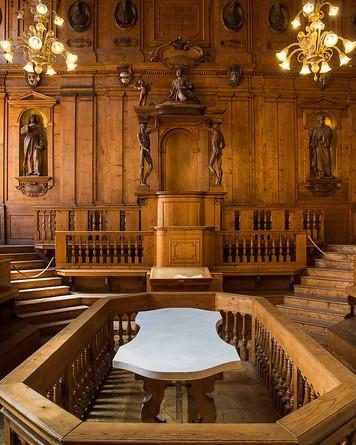
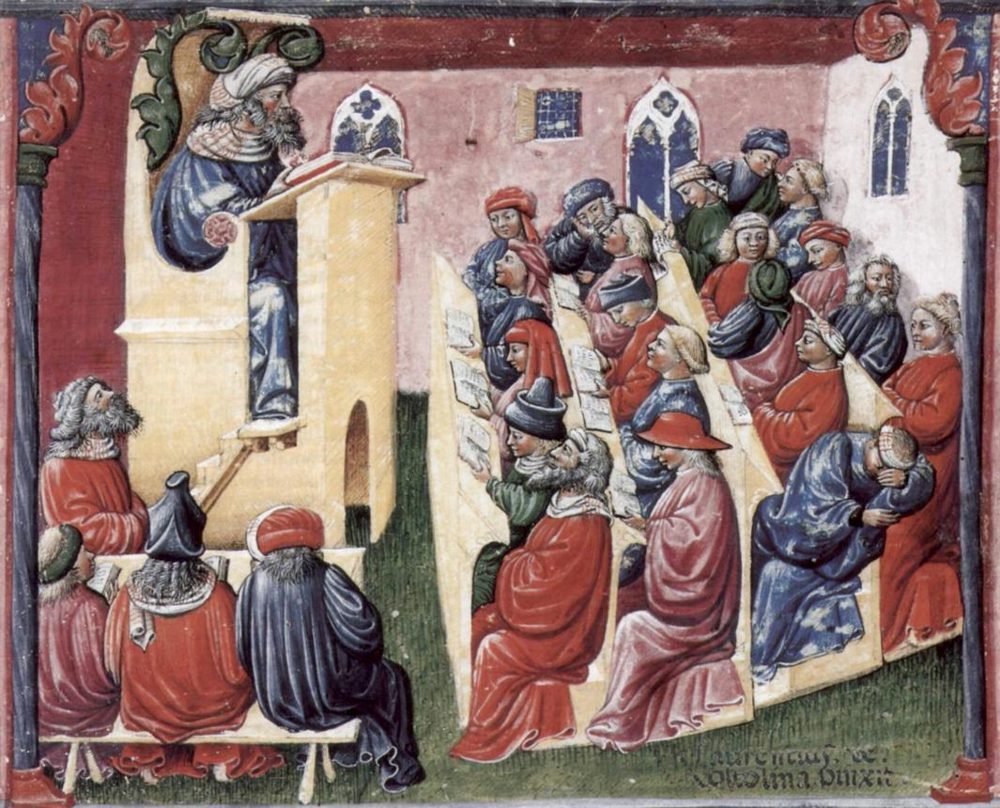
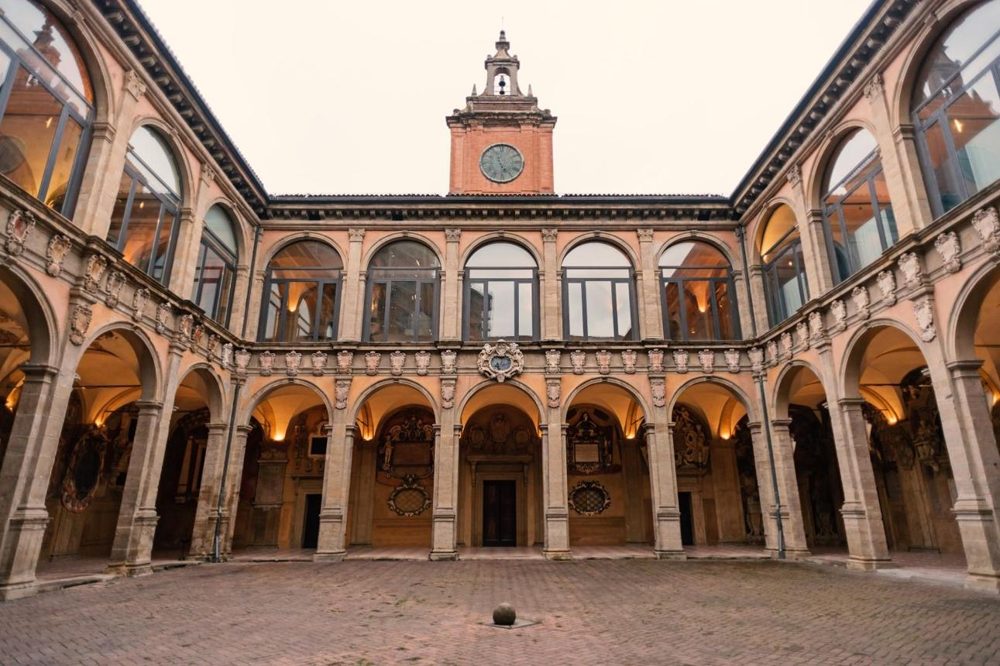
7
Bologna became one of the most important centers of medieval higher learning, particularly in law.
Its development is usually associated with the revival of Roman law and the activities of scholars who taught and interpreted legal texts.
The university's origins are traditionally associated with the late eleventh century, although, as with many medieval institutions, there was no single founding event equivalent to the opening of a modern university campus.
Bologna developed through a process of institutional formation.
The city became attractive to students seeking advanced legal education.
Students came from different regions.
They required accommodation, protection, teachers, and mechanisms for regulating relationships with the city.
The result was a powerful corporate organization.
Bologna became particularly notable for the strength of its student organization.
8. Why Law Became So Important
The rise of Bologna cannot be separated from the renewed importance of law.
Medieval Europe experienced expanding political, commercial, ecclesiastical, and administrative complexity.
Law was needed for:
- property;
- contracts;
- inheritance;
- government;
- church administration;
- commercial relationships;
- taxation;
- diplomacy;
- and judicial procedures.
The rediscovery and systematic study of Roman law therefore had enormous significance.
The Corpus Juris Civilis associated with Emperor Justinian became an important foundation for the study of civil law in medieval Europe.
Scholars such as Irnerius became associated with the revival of Roman legal studies at Bologna (Rashdall, 1936).
Students trained in law could enter influential professions.
This gave legal education substantial economic and political value.
9. Bologna and Student Power
Bologna's organization differed from Paris.
At Bologna, students played a particularly important role in the university's corporate structure.
Student groups organized themselves into associations based partly on geographical origin, often described as nationes.
These organizations could negotiate with masters concerning teaching arrangements, fees, and academic conditions.
The relationship between masters and students therefore involved bargaining.
This is important because it challenges the assumption that medieval education was simply hierarchical and authoritarian.
Medieval universities could be sites of institutional negotiation.
Students were not merely passive recipients.
They could become organized political actors within the academic community.
10. The Teacher as a Contractual Professional
The Bologna model also illustrates an interesting relationship between teacher and learner.
Students depended upon masters for instruction.
Masters depended upon students for income and professional standing.
This created incentives for both sides.
Students wanted effective teachers.
Masters wanted students.
The university therefore developed mechanisms to regulate this relationship.
This provides an early example of a principle that remains important in higher education:
academic quality depends partly upon institutional structures that align the interests of teachers, students, and the wider scholarly community.
11. Paris: The University of Masters
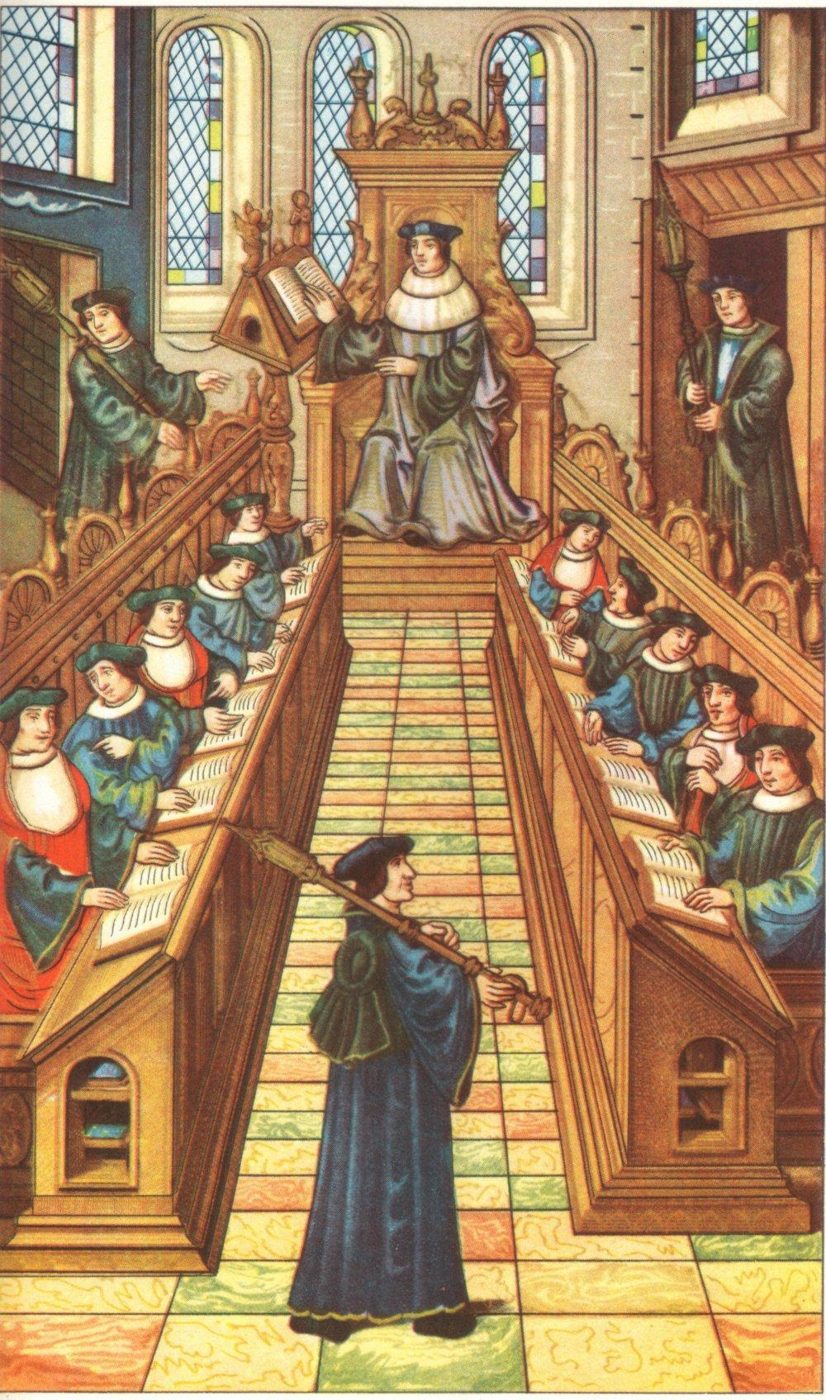
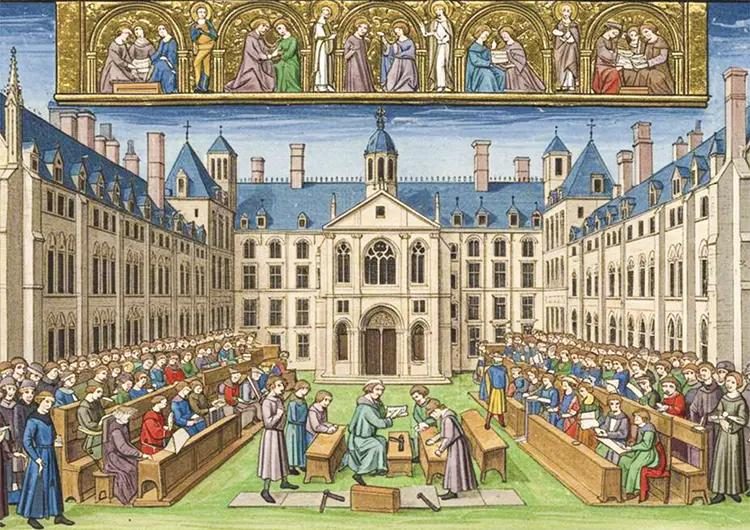
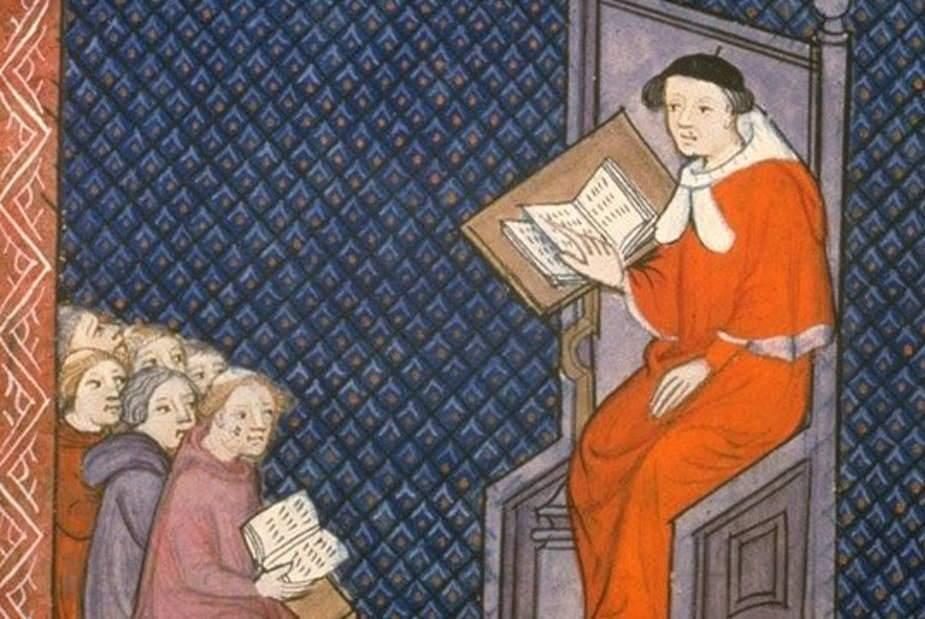
7
If Bologna became particularly associated with law and student organization, Paris became especially important for theology, philosophy, and the organization of masters.
The schools of Paris developed around the cathedral of Notre-Dame and other intellectual centers.
By around 1200, Paris had developed into one of Europe's principal centers of advanced learning. The Stanford Encyclopedia of Philosophy notes that Paris had become a university by about 1200, with Oxford developing at approximately the same time.
Paris became particularly influential in the development of scholasticism.
The university's importance was closely connected to theology, philosophy, logic, and the expanding availability of Aristotle and other philosophical works.
12. Peter Abelard

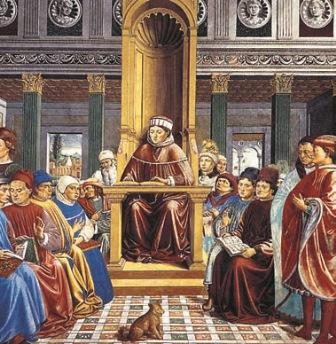
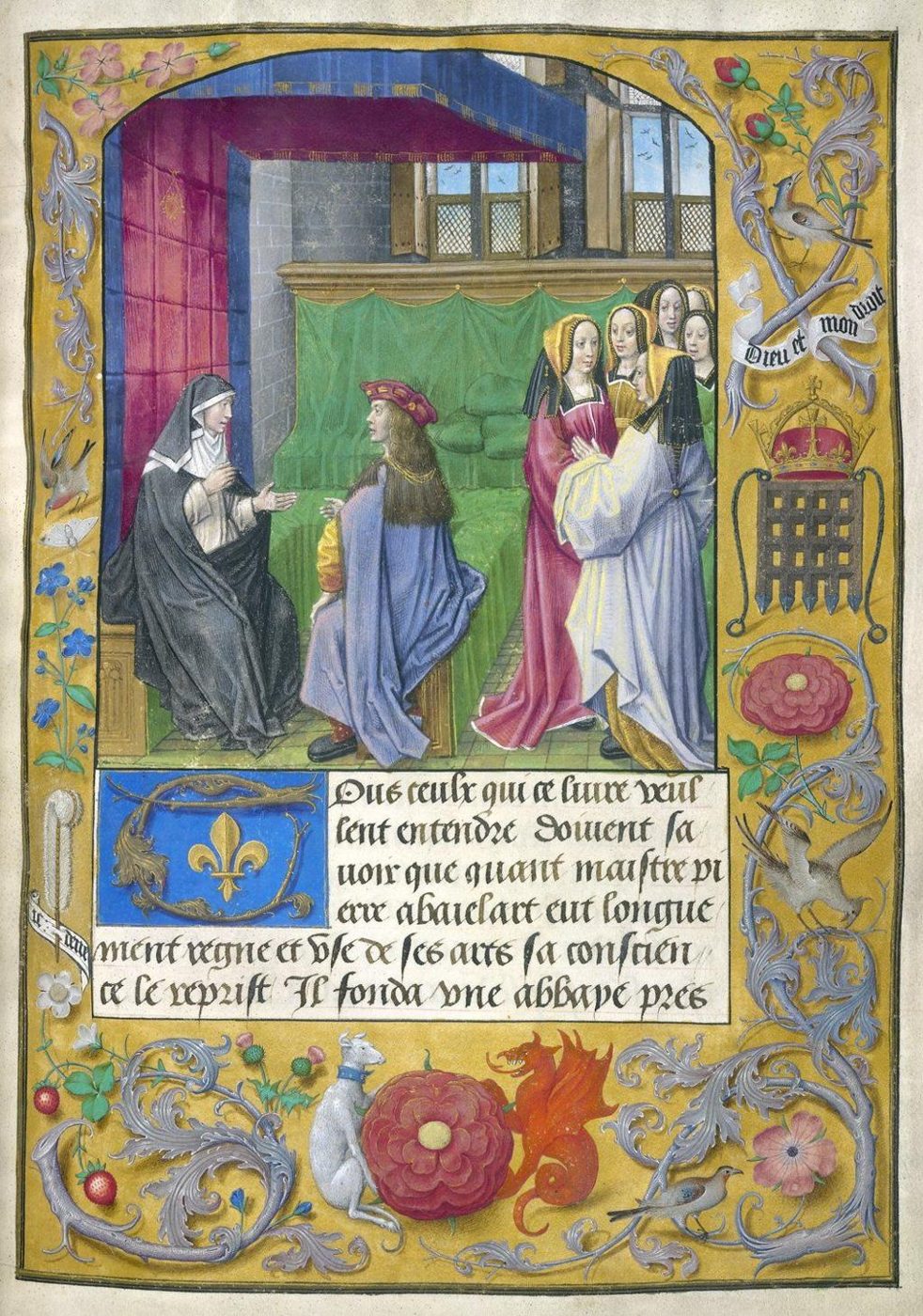
6
Few figures better illustrate the intellectual transformation of twelfth-century education than Peter Abelard.
Abelard was a philosopher, theologian, teacher, and controversial intellectual figure whose career was closely associated with the schools of Paris.
He became famous for his dialectical method and his willingness to confront difficult theological and philosophical questions.
His work Sic et Non ("Yes and No") presented apparently contradictory statements from authoritative Christian writers.
The pedagogical significance was profound.
Abelard was encouraging students to confront disagreement.
Instead of assuming that authorities always appeared to agree, the student had to investigate why apparently contradictory statements existed.
This approach exemplifies the scholastic principle that intellectual difficulty can be a tool for learning.
13. Abelard and the Discipline of Questioning
Abelard's approach illustrates a central principle of mastery:
Do not fear difficult questions.
The beginning of advanced learning is often uncertainty.
A beginner wants simple answers.
A scholar learns that important questions frequently have complicated answers.
A master learns to identify the assumptions hidden within the question itself.
Abelard's dialectical method helped create an educational culture in which intellectual disagreement could become methodologically productive.
This was a major step toward systematic academic debate.
14. Scholasticism
Scholasticism was not simply a single doctrine.
It was a broad intellectual tradition and set of educational methods that flourished in medieval schools and universities.
Its characteristic features included:
- careful reading of authoritative texts;
- logical analysis;
- formulation of questions;
- presentation of arguments;
- consideration of objections;
- distinctions;
- responses;
- and systematic conclusions.
The method was heavily influenced by Aristotelian logic and by Christian theological concerns.
Scholasticism sought to understand how reason and revealed faith could relate to one another.
It was therefore not simply an attempt to memorize religious doctrine.
It represented a sustained intellectual effort to examine difficult questions through disciplined reasoning.
15. The Lectio
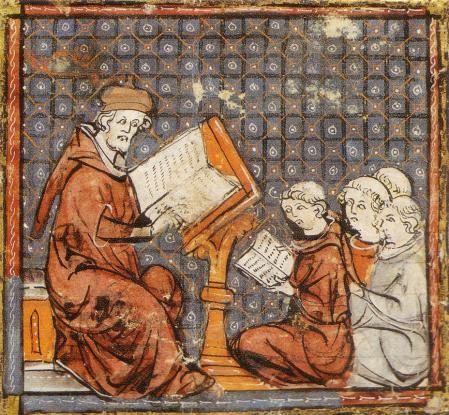
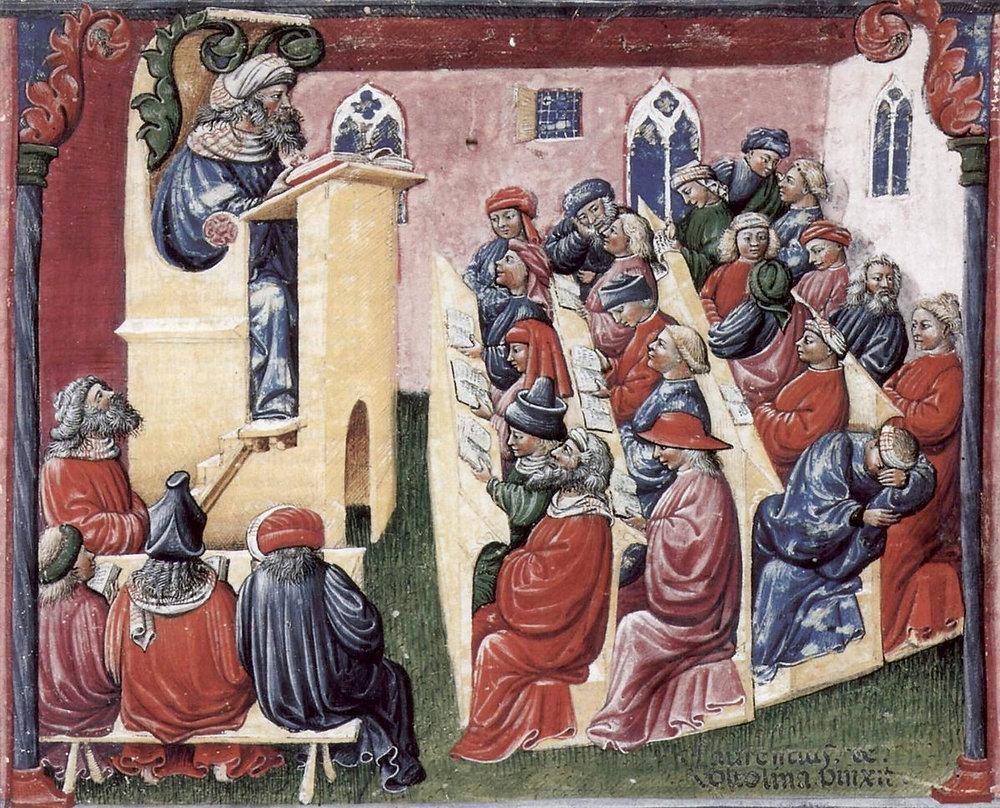
One of the fundamental teaching methods of medieval universities was the lectio, or lecture.
The word "lecture" has modern associations with a professor speaking to students.
The medieval lectio was more closely connected with reading and explaining authoritative texts.
The master would read a text and explain it.
The explanation could involve:
- interpretation of difficult passages;
- clarification of terminology;
- comparison with other authorities;
- logical analysis;
- and application to larger questions.
At Cambridge, the historical description of the medieval university explains that teaching involved reading and explaining texts, while examinations were conducted through oral disputations.
This is an important distinction.
The medieval lecture was not simply information delivery.
It was textual interpretation.
16. The Disputatio
The second major educational method was the disputatio, or disputation.
A question would be presented.
Arguments could be offered on different sides.
Objections would be raised.
Responses would be developed.
The master would eventually provide a determination.
This method trained students to:
- construct arguments;
- identify weaknesses;
- respond to objections;
- distinguish concepts;
- evaluate evidence;
- and defend conclusions.
In many respects, this resembles aspects of modern academic defense and peer review.
The difference is that medieval disputation occurred within a theological and philosophical framework and followed highly formal conventions.
17. The Quaestio
The quaestio, or question, was another central feature of scholastic education.
Rather than asking only for factual information, students were confronted with difficult intellectual problems.
For example:
Can human reason demonstrate the existence of God?
Can a just person possess wealth?
What is the relationship between faith and reason?
What makes an action morally good?
These questions required argument rather than memorization.
The educational objective was therefore to develop intellectual capacity.
The student had to learn how to think through problems.
18. Thomas Aquinas
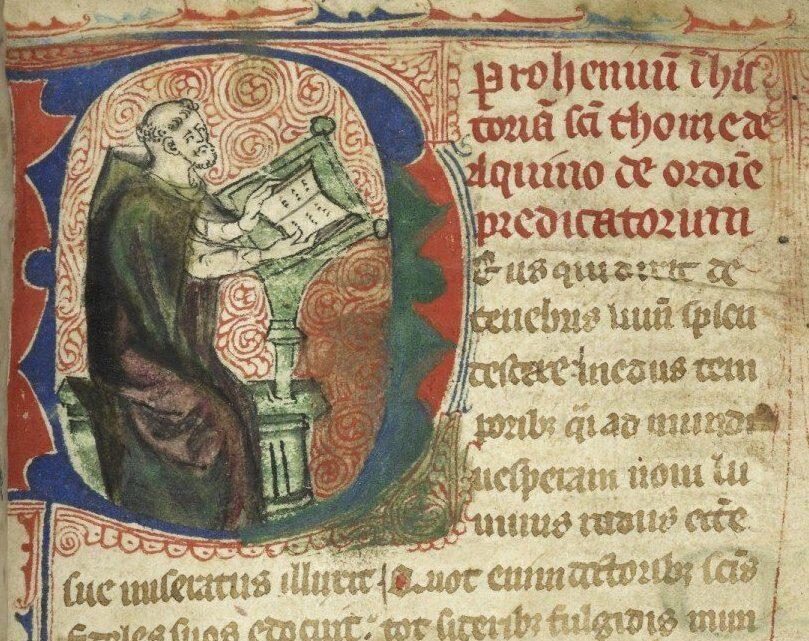
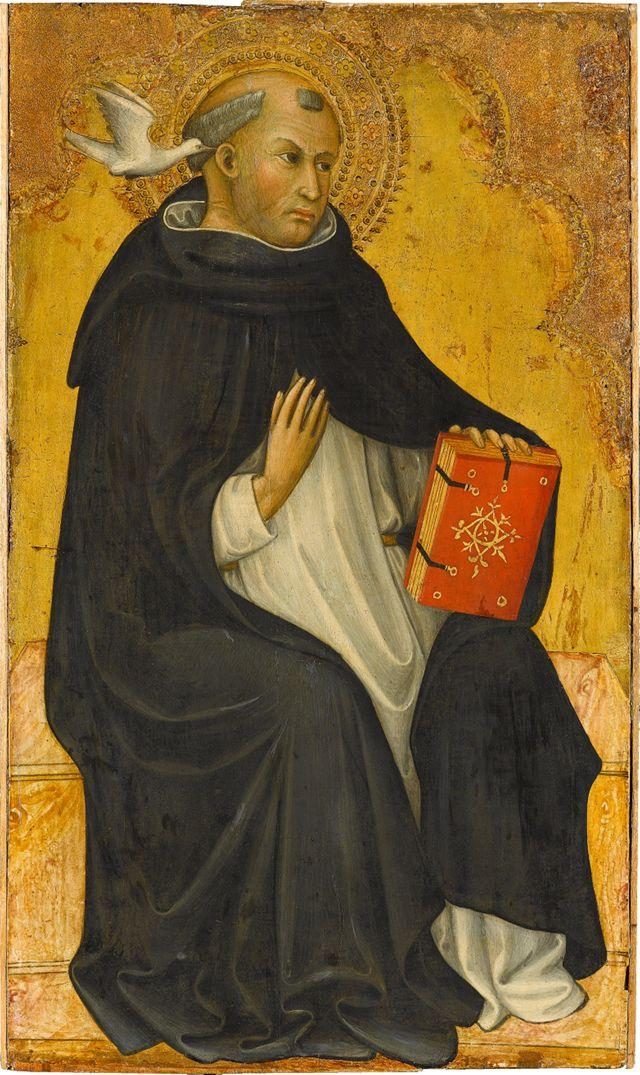
7
Thomas Aquinas represents perhaps the most famous expression of mature medieval scholasticism.
Born in the thirteenth century, Aquinas became a Dominican friar, philosopher, theologian, and teacher.
His intellectual work was deeply shaped by Aristotle, Christian theology, scripture, and earlier thinkers.
His Summa Theologiae became one of the most influential works in medieval Christian theology.
Aquinas attempted to organize enormous bodies of theological and philosophical material into systematic structures.
His method exemplifies mastery through organization, distinction, argument, response, and synthesis.
19. Aquinas and Faith and Reason
One of Aquinas's major intellectual concerns involved the relationship between faith and reason.
He did not treat rational inquiry as necessarily opposed to religious faith.
Instead, he distinguished different ways of knowing and considered how philosophical reasoning could contribute to theological understanding (Aquinas, trans. 1981–1987).
This is important for the history of higher education because medieval universities created an environment in which philosophy, theology, law, and other disciplines could interact.
The intellectual relationship was sometimes harmonious and sometimes contentious.
But the university provided a structured environment in which such disagreements could be debated.
20. Aristotle Returns to Europe
The emergence of medieval scholasticism cannot be understood without considering the recovery and translation of Aristotle.
Western European scholars gained access to increasingly large portions of Aristotle's philosophical corpus during the twelfth and thirteenth centuries.
Some works were transmitted through Arabic scholarly traditions and translations from Arabic into Latin; others were translated directly from Greek into Latin.
Scholars such as Avicenna and Averroes had themselves developed extensive philosophical interpretations of Aristotle.
The circulation of these works dramatically expanded the intellectual resources available to European scholars.
The Cambridge history of medieval universities notes that the thirteenth century saw rapid engagement by arts masters and theologians with Aristotle's works and with the interpretations of Avicenna and Averroes.
21. The Church and the University
The medieval university developed within a deeply Christian European society.
Consequently, the Church played a major role in its development.
But the relationship should not be oversimplified as "the Church controlled everything."
The actual relationship was more complicated.
Church authorities:
- supported schools;
- provided educated clergy;
- participated in university governance;
- granted privileges;
- controlled ecclesiastical appointments;
- regulated theological teaching;
- and sometimes restricted particular intellectual works.
At the same time, universities developed corporate privileges and forms of self-government.
Masters could organize themselves.
Students could organize themselves.
Universities could negotiate privileges with rulers and ecclesiastical authorities.
The relationship therefore involved both dependence and negotiation.
22. The University and the Church's Intellectual Mission
Theology was regarded as an exceptionally important field.
The Christian intellectual tradition regarded knowledge of God and scripture as central to the purpose of learning.
Consequently, theology occupied the highest position within the medieval hierarchy of academic disciplines.
Yet this did not mean that other disciplines were unimportant.
Law, medicine, philosophy, grammar, logic, mathematics, astronomy, and rhetoric all developed within the university environment.
The relationship between theology and secular disciplines became one of the defining intellectual tensions of the period.
23. The Faculty Structure
Medieval universities gradually developed faculties.
A typical hierarchy included:
Faculty of Arts
This provided foundational education.
Students studied subjects associated with the trivium:
- grammar;
- rhetoric;
- dialectic/logic.
They also studied the quadrivium:
- arithmetic;
- geometry;
- music;
- astronomy.
Higher Faculties
More advanced study could involve:
- theology;
- law;
- medicine.
The Stanford Encyclopedia of Philosophy describes medieval universities as divided into Arts Faculties and higher faculties of Theology, Law, and Medicine.
The Arts Faculty therefore functioned partly as a foundation for advanced study.
24. The Trivium
The trivium represented three foundational intellectual disciplines.
Grammar
Grammar provided command of language.
Rhetoric
Rhetoric developed effective communication and argument.
Dialectic
Dialectic developed logical reasoning and the analysis of arguments.
Together, these disciplines created a foundation for scholarly communication.
The modern equivalents are not exact, but the underlying principle remains highly relevant.
A scholar needs:
language + communication + reasoning.
Without language, ideas cannot be clearly expressed.
Without reasoning, claims cannot be evaluated.
Without communication, knowledge cannot effectively reach others.
25. The Quadrivium
The quadrivium consisted of:
- arithmetic;
- geometry;
- music;
- astronomy.
These subjects were associated with mathematical relationships and structured reasoning.
The medieval curriculum therefore sought to cultivate both linguistic and mathematical capacities.
This illustrates that medieval education was not simply theological.
The curriculum encompassed several intellectual traditions.
26. Degree Hierarchy
One of the most enduring legacies of the medieval university is the development of recognizable academic degrees.
The medieval system did not correspond exactly to the modern hierarchy, but important precedents emerged.
Common stages included:
- bachelor;
- master;
- doctor.
There could also be a licentiate, particularly associated with authorization to teach.
The historical development of these terms was complex and varied among universities.
Nevertheless, a basic developmental pattern emerged:
beginning student → advanced student → qualified teacher/master → doctor
This structure helped institutionalize academic progression.
27. The Bachelor
The medieval baccalaureus, or bachelor, represented an early stage of academic advancement.
The bachelor had achieved sufficient competence to undertake certain academic responsibilities but was not yet a fully independent master.
At some institutions, bachelors could participate in teaching under supervision.
This is significant because it demonstrates that university education was not simply a sequence of courses.
It involved gradual entry into the profession of teaching.
The student became part of the academic community before becoming a master.
28. The Master
The master represented a higher level of academic achievement.
The master was generally qualified to teach within the relevant faculty and participate more fully in academic life.
The historical development of academic degrees was closely connected with the professional status of teaching.
The modern degree called a "Master's degree" has evolved considerably, and it should not be assumed to be identical to the medieval magister.
Nevertheless, the linguistic and historical connection is important.
The medieval master was fundamentally a teacher and scholar.
29. The Doctor
The word doctor derives from the Latin docere, meaning "to teach."
This etymology is revealing.
The doctorate was historically associated with teaching authority.
The highest academic qualification was therefore closely connected with the ability and right to teach.
The modern doctorate has developed additional meanings, particularly research expertise and original contribution to knowledge.
But its historical foundation reminds us that the highest form of academic achievement was once intimately connected with teaching others.
30. Licentia Docendi
One of the most important concepts in medieval academic history is the licentia docendi, literally a "license to teach."
In earlier ecclesiastical educational structures, authorization to teach could be associated with church authorities.
As universities developed, the relationship between ecclesiastical authority and university authority became increasingly institutionalized.
The license represented recognized permission to teach.
This was more than a certificate.
It was a statement that the individual had reached a recognized standard of competence.
The historical record also shows the development of the broader principle of jus ubique docendi, meaning a right or authorization to teach elsewhere. The details differed by institution and period, but the idea became associated with the portability of academic qualification.
This represents an extraordinary historical development.
A qualification could become a form of portable intellectual authority.
31. Why the License to Teach Mattered
The licentia docendi addressed an important institutional problem.
If anyone could simply announce themselves as a teacher, how would students know whether that person was qualified?
The university developed mechanisms for recognition.
Qualification became institutional.
The community of masters helped determine who could enter the teaching profession.
This principle survives in modern professional education.
Universities certify graduates.
Professional bodies certify practitioners.
Licensing authorities regulate occupations.
Academic communities evaluate researchers.
The medieval university helped establish an enduring relationship:
competence → examination → recognition → authority to practice or teach.
32. The Guild Analogy and Academic Progression
The academic hierarchy can be compared conceptually with guild progression.
A craft guild might involve:
apprentice → journeyman → master
The university developed something resembling:
student → bachelor → master/doctor
The analogy is not exact.
Academic and craft institutions had different purposes and legal structures.
Nevertheless, both systems recognized that mastery should involve stages.
The novice should not immediately become a master.
Competence must be demonstrated.
The community must recognize achievement.
The master then acquires authority to train others.
This is one of the oldest principles of professional education.
33. Oxford
8
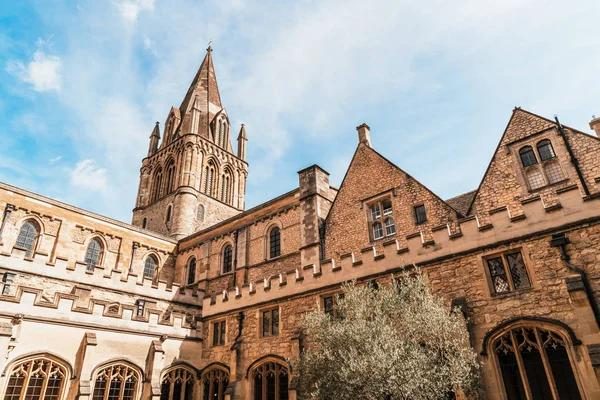
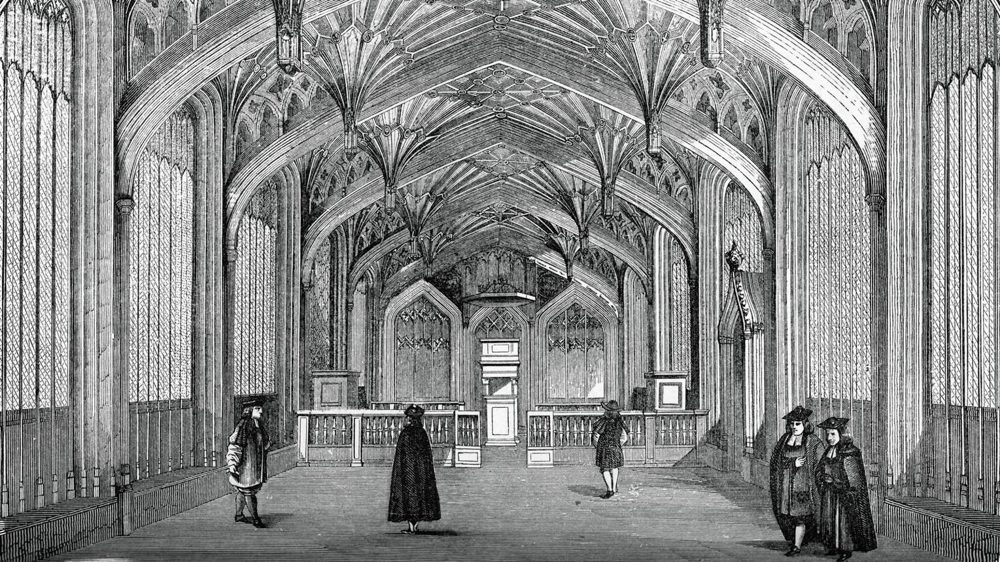
Oxford emerged as another major center of medieval learning.
The University of Oxford states that teaching existed at Oxford in some form by 1096, although there is no clear single foundation date. Oxford developed rapidly after 1167, when Henry II restricted English students from attending the University of Paris.
This episode illustrates an important feature of medieval intellectual life:
scholars moved.
Students and masters migrated between intellectual centers.
Political events could therefore alter the geography of knowledge.
Oxford benefited from the movement of scholars away from Paris.
34. Oxford and the International Nature of Medieval Scholarship
Oxford did not develop in isolation.
Its scholars participated in wider European intellectual networks.
Students could come from different regions.
Books circulated.
Masters traveled.
Ideas crossed political boundaries.
The medieval university was therefore more international than might initially be assumed.
Latin served as a major scholarly language across much of Western Christendom.
A scholar trained in one region could potentially communicate with scholars elsewhere.
This created an early transnational intellectual community.
35. Oxford's Academic Organization
Oxford developed a corporate identity and eventually a chancellor.
The university's own historical account notes that a magister scholarum Oxonie headed the academic community by around 1201, with the title of Chancellor formally associated with the office by 1214; in 1231 the masters were recognized as a universitas or corporation.
This is significant.
The institution was becoming legally and organizationally recognizable.
The academic community was no longer merely a collection of individual teachers.
It had institutional identity.
36. Town and Gown
Medieval universities existed within towns.
This created opportunities and conflicts.
Students needed:
- food;
- accommodation;
- books;
- clothing;
- services;
- entertainment;
- and other goods.
Town residents wanted income.
Students wanted reasonable prices.
Universities wanted privileges.
Local authorities wanted order.
These competing interests could produce conflict.
The famous medieval distinction between town and gown reflects this relationship.
Oxford experienced tensions between scholars and townspeople, contributing to the development of protected academic residences and eventually colleges.
37. The Emergence of Colleges
The development of colleges was one of the most important innovations associated with Oxford and Cambridge.
Early university students could live in rented accommodation or hostels.
Over time, endowed colleges developed.
These institutions provided:
- accommodation;
- meals;
- supervision;
- worship;
- scholarships;
- academic community;
- and eventually teaching.
The college system therefore created another layer of academic organization.
The university became a federation or network of communities rather than simply one centralized institution.
38. Cambridge
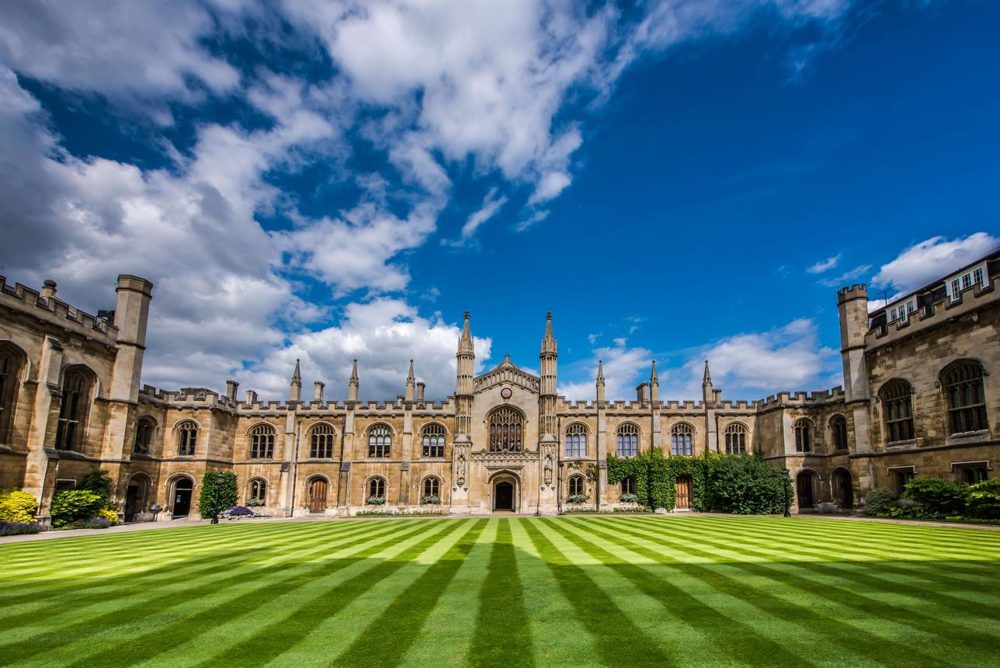
8
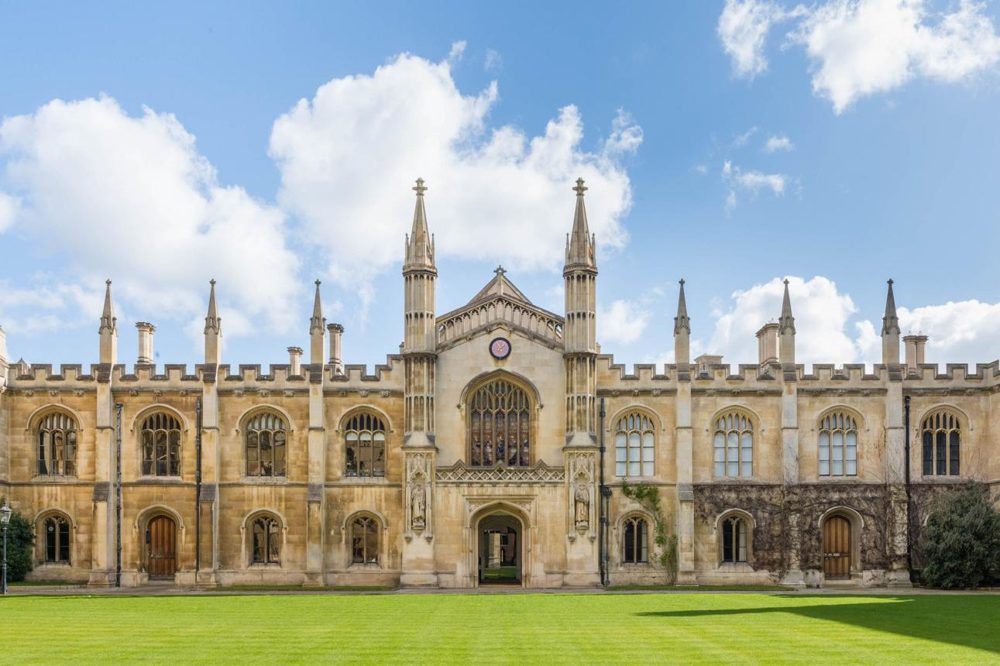
Cambridge developed from a migration of scholars associated with Oxford.
The University of Cambridge dates its earliest university community to 1209. Its official history explains that scholars fleeing Oxford settled in Cambridge after conflict there, and by 1226 the scholars had organized themselves sufficiently to have a chancellor and regular courses of study.
This origin demonstrates again that universities were communities of mobile scholars.
Knowledge moved with people.
Institutions could emerge from migration.
Academic communities were not necessarily tied permanently to one location.
39. Cambridge and Academic Self-Government
Cambridge gradually developed structures of self-governance.
The university created officers such as:
- Chancellor;
- Proctors;
- Bedells;
- and other officials.
Statutes were developed to regulate the community.
The historical record describes the university's statutes as evolving through practical experience and institutional needs.
This is an important characteristic of institutional maturity.
An academic community cannot depend entirely upon informal relationships.
As the community grows, it requires:
- rules;
- procedures;
- records;
- offices;
- accountability;
- and mechanisms for resolving disputes.
The medieval university therefore became not only an intellectual institution but also a governance institution.
40. Cambridge and the Degree System
The Cambridge model also demonstrates the development of academic progression.
Students studied foundational arts.
They could progress toward bachelor and master degrees.
Some advanced to theology, law, or medicine.
The university's historical account describes teaching by masters, oral examinations through disputation, and the development of degree grades as stages in scholarly progress.
This is a direct ancestor of modern academic progression.
41. Salamanca
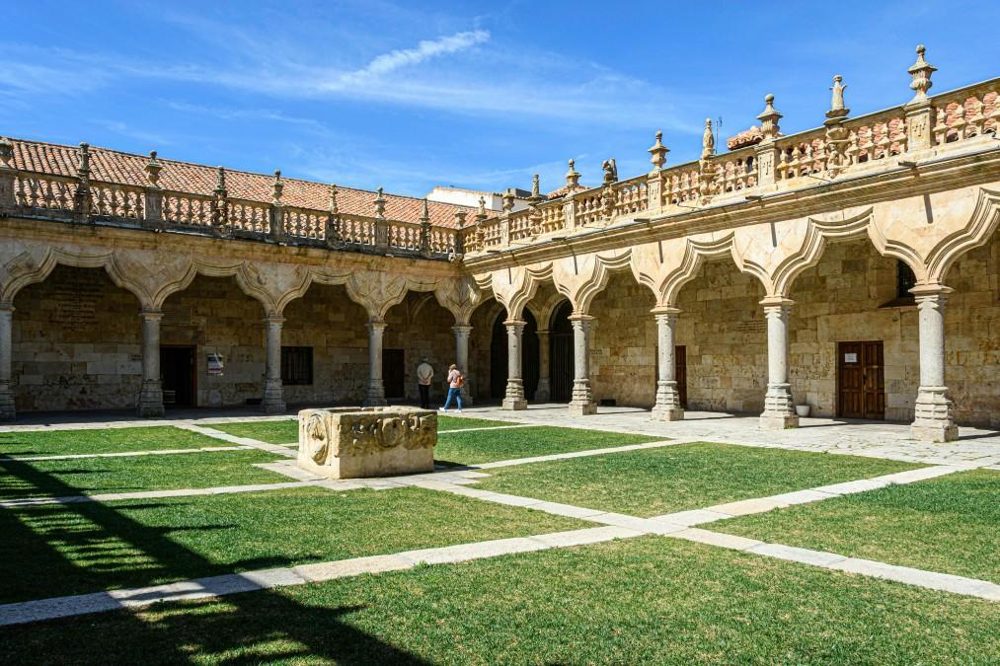
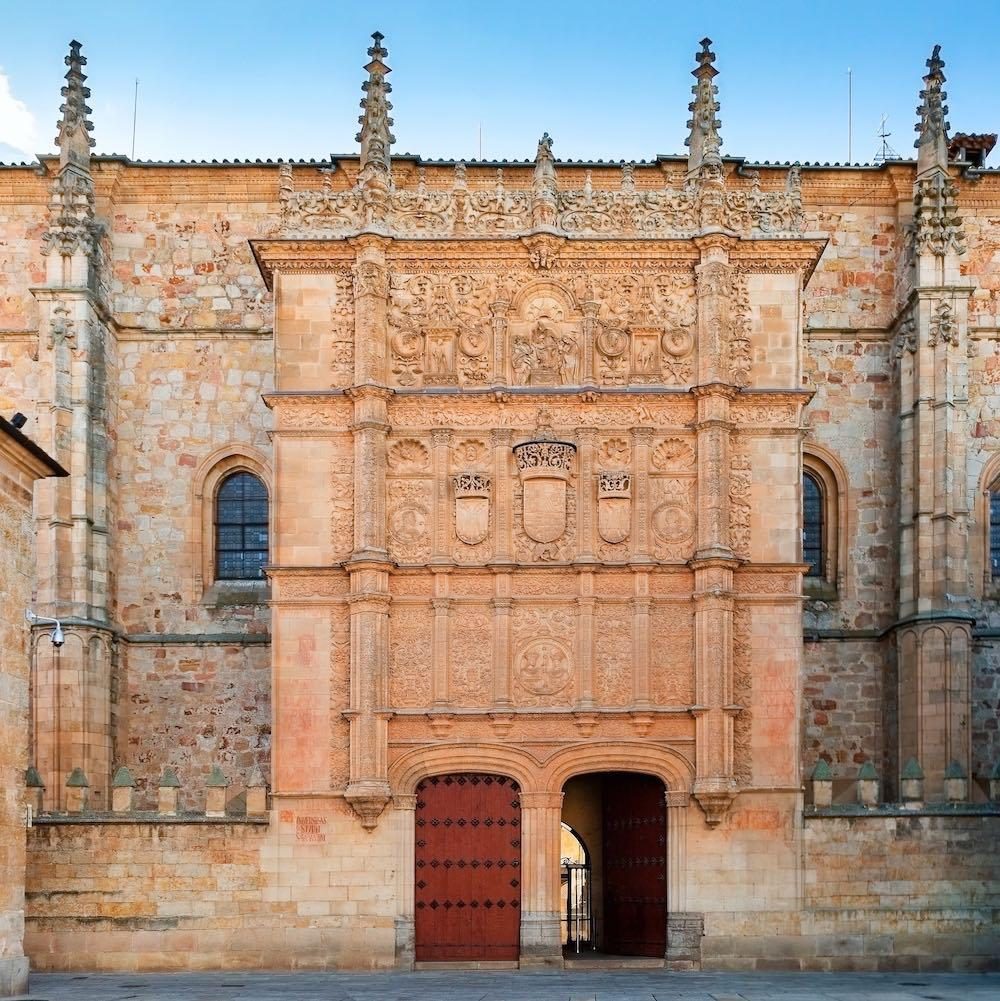
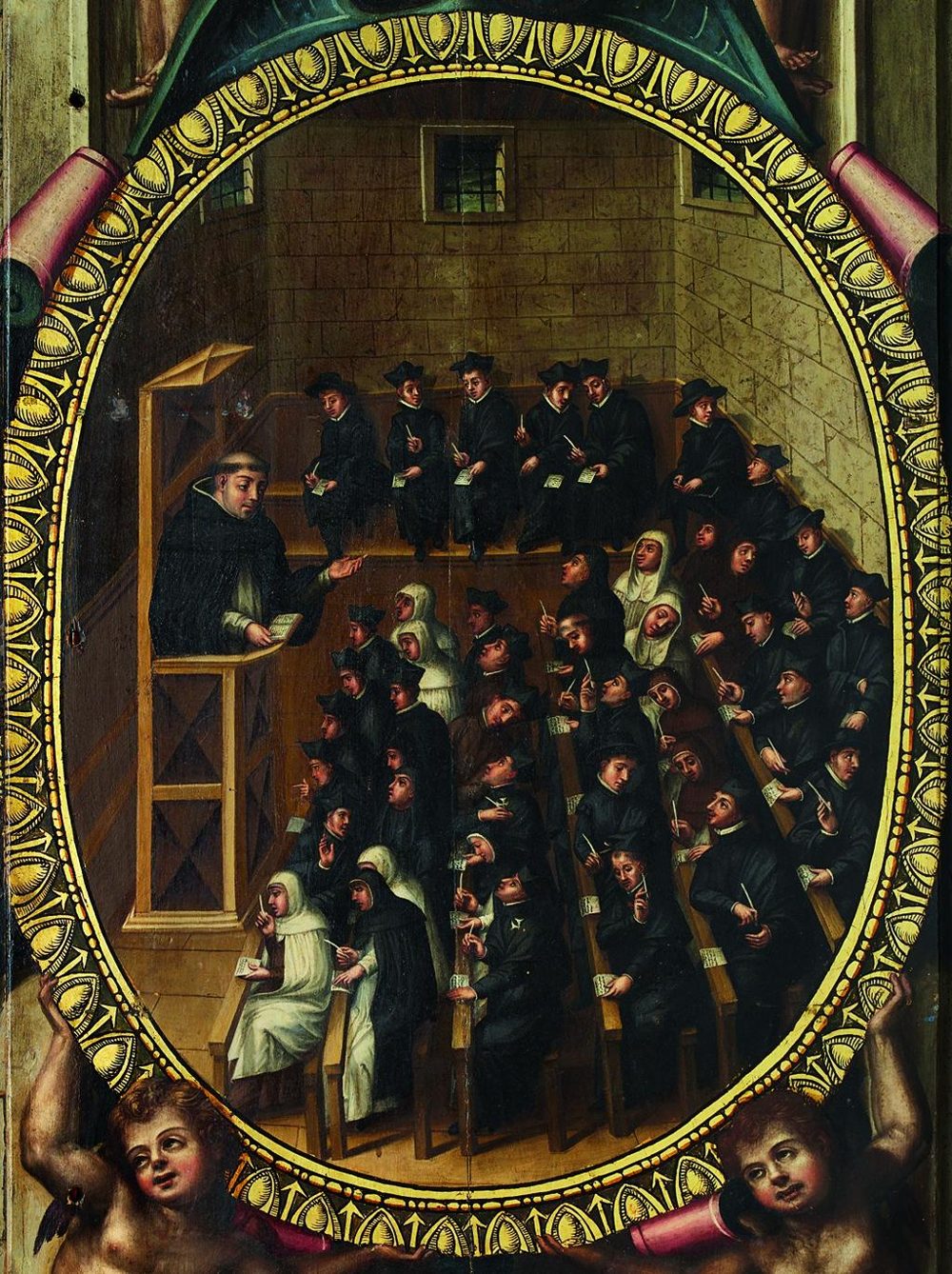
7
The University of Salamanca represents another important stage in the development of European higher education.
Founded in the early thirteenth century, Salamanca became one of the major centers of learning in the Iberian Peninsula.
Its development occurred within a different political and cultural environment from Bologna, Paris, Oxford, and Cambridge.
The Iberian Peninsula was a major zone of interaction among Christian, Jewish, and Muslim intellectual traditions.
This broader environment contributed to the transmission and transformation of knowledge across linguistic and religious boundaries.
Salamanca eventually became particularly influential in law, theology, philosophy, and related fields.
42. Salamanca and the Wider European Academic Network
The development of Salamanca demonstrates that the university model spread.
Universities did not simply emerge independently in isolated locations.
There was a growing European network of institutions.
Students and masters moved.
Books circulated.
Academic privileges were sought from popes and rulers.
Curricula influenced one another.
Academic titles acquired increasing international significance.
This created something historically remarkable:
a transnational system of higher learning.
Medieval Europe was politically fragmented.
Yet its universities were connected by common intellectual traditions and, above all, by Latin as a scholarly language.
43. Latin as the Language of Scholarship
Latin was one of the most important technologies of medieval academic integration.
A student from one region could study in another.
A master trained in one university could teach elsewhere.
A legal text written in one country could be studied in another.
A theological argument could circulate across national boundaries.
This created a shared intellectual language.
It was not accessible to everyone.
Literacy itself was highly unequal.
Nevertheless, within the scholarly community, Latin facilitated international communication.
In this sense, medieval Europe possessed an intellectual network that crossed political borders.
44. The International Scholar
The medieval scholar could therefore develop an identity that transcended local geography.
A person might be:
- born in one country;
- educated in another;
- teach in a third;
- write in Latin;
- correspond with scholars elsewhere;
- and participate in an intellectual tradition that was not limited to a single nation.
This phenomenon has parallels with contemporary academia.
Today, scholars move between countries.
They publish internationally.
They collaborate across borders.
They participate in international conferences.
They teach global students.
The medieval university was an early form of international academic community.
45. The Church's Institutional Role
The Church played multiple roles in university development.
It supplied many teachers.
It provided institutional legitimacy.
It maintained cathedral schools.
It employed educated clergy.
It supported theological education.
Popes could grant privileges.
Bishops could participate in university governance.
Yet the relationship between universities and ecclesiastical authorities was not always harmonious.
Universities increasingly developed their own corporate identities.
Masters and students defended academic privileges.
Disagreements occurred concerning:
- who could teach;
- who could grant qualifications;
- which books could be taught;
- disciplinary authority;
- taxation;
- and legal jurisdiction.
Thus, university history is partly a history of negotiation over intellectual authority.
46. Academic Freedom in Historical Perspective
The medieval university did not possess academic freedom in the modern sense.
There were significant intellectual and theological boundaries.
Certain propositions could be condemned.
Certain texts could be restricted.
Theology operated within Christian doctrinal commitments.
Nevertheless, the university's corporate structure created spaces in which difficult questions could be debated.
The formal disputation is evidence of this.
The existence of structured disagreement does not mean unlimited freedom.
But it does show that intellectual argument was institutionalized.
This is one of the university's great historical contributions.
47. Condemnations and Intellectual Conflict
The thirteenth century witnessed significant conflicts concerning Aristotelian philosophy and its relationship to Christian theology.
Some Aristotelian ideas were viewed with suspicion.
Certain propositions associated with philosophical interpretations were condemned in Paris in the thirteenth century.
The response was not uniform across Europe.
Over time, Aristotelian philosophy became deeply integrated into university curricula.
The historical process illustrates an important characteristic of intellectual institutions:
new knowledge can initially appear threatening before becoming integrated into established systems.
This pattern remains relevant.
Universities continually encounter new theories, technologies, methods, and discoveries.
The history of Aristotle's reception demonstrates that intellectual transformation is rarely frictionless.
48. Scholasticism as a Technology of Thought
Scholasticism can be understood as an intellectual technology.
It provided procedures for handling difficult questions.
The process often involved:
- stating a question;
- presenting objections;
- identifying authoritative sources;
- developing counterarguments;
- distinguishing concepts;
- constructing a response;
- resolving objections;
- reaching a conclusion.
This method trained intellectual discipline.
It discouraged purely intuitive answers.
It encouraged explicit reasoning.
It required engagement with opposing positions.
It made intellectual disagreements visible.
This is why scholasticism remains historically significant even when many medieval conclusions are no longer accepted.
The method of disciplined argument had enduring value.
49. The Importance of Authorities
Medieval scholars worked extensively with authoritative texts.
Authorities could include:
- scripture;
- Church Fathers;
- Aristotle;
- Roman law;
- canon law;
- earlier theologians;
- and other recognized sources.
The scholar's task was often to interpret and reconcile authorities.
Modern scholarship places greater emphasis on empirical research and original evidence in many fields, but contemporary scholars still work within intellectual traditions.
Every academic discipline has canonical texts, established theories, methods, and major thinkers.
The medieval scholar's engagement with authority therefore has a modern parallel:
scholarship begins with knowing what has already been said.
Only after understanding the existing tradition can the researcher meaningfully challenge it.
50. From Commentary to Original Contribution
A medieval student often began by studying established texts.
The student learned the tradition.
The student interpreted it.
The student debated its implications.
Eventually, the scholar could contribute something new.
This developmental pattern remains central to doctoral education.
A doctoral researcher must understand:
- what is already known;
- what is disputed;
- what evidence exists;
- what methods have been used;
- what limitations remain;
- and what new contribution can be made.
The modern doctoral dissertation therefore preserves part of an ancient and medieval intellectual principle:
original contribution emerges from deep engagement with inherited knowledge.
51. Examinations Before Written Examinations
Modern students often imagine examinations as written papers.
Medieval university examinations were frequently oral.
At Cambridge, the university's history explicitly describes degree examinations as oral disputations in which candidates defended questions or theses before other students and masters.
This form of examination tested more than memory.
It tested:
- reasoning;
- verbal communication;
- responsiveness;
- intellectual flexibility;
- and the ability to defend an argument.
A student could not simply memorize an essay and reproduce it.
The student had to respond to questions.
This resembles modern doctoral vivas in important respects.
52. The Medieval Viva and the Modern Defense
The modern doctoral defense or viva has a surprisingly deep historical connection with oral disputation.
A doctoral candidate today may be asked:
- Why did you choose this methodology?
- Why is your research question important?
- What is your contribution?
- Why did you reject alternative explanations?
- What are the limitations?
- What would you do differently?
- How does your work relate to existing scholarship?
These questions require intellectual defense.
The medieval disputation similarly required candidates to demonstrate command of their subject.
The fundamental educational principle is:
A scholar should be able to defend what the scholar claims to know.
53. The Examination as a Test of Mastery
The examination therefore had a deeper purpose than sorting students into grades.
It tested whether the student had entered the intellectual community sufficiently to participate in it.
The candidate had to demonstrate:
knowledge + reasoning + communication + judgment.
This is a much richer concept than simple factual recall.
The examination became a rite of academic passage.
After successful examination, the candidate received a recognized status.
The person was no longer simply a student.
The person had become a member of a scholarly profession.
54. Matriculation and Academic Identity
As universities became more organized, they needed to identify their members.
Cambridge's historical account notes the importance of enrolment with a licensed master and the later assumption of this function by the university itself. This process was associated with matriculation.
Matriculation therefore became more than registration.
It marked entry into the academic community.
The student became part of an institution.
Modern university matriculation retains this symbolic meaning.
55. Graduation as Admission to a Community
The word graduation is associated historically with progression through grades.
A degree was not merely a document.
It represented admission to a particular academic status.
The successful candidate became:
- bachelor;
- master;
- doctor;
- or another recognized academic member.
Academic dress, ceremonies, and titles reinforced this transformation.
Many modern university traditions therefore preserve medieval institutional symbolism.
The gown, hood, cap, procession, academic titles, and formal ceremonies all have deep historical roots.
56. The Academic Gown and the Visibility of Status
Academic dress served practical and symbolic functions.
It marked membership.
It distinguished academic rank.
It made academic status visible.
Different levels of qualification could be reflected in dress.
Although contemporary academic dress is largely ceremonial, its historical meaning was connected with social identity.
The academic community became recognizable as a distinct corporate group.
This illustrates a broader principle:
institutions reinforce identity through symbols.
57. Books and the Medieval University
Books were central to medieval higher education.
But books were expensive.
Before printing, manuscripts had to be copied by hand.
This meant that access to texts could be limited.
Universities therefore developed systems for managing books.
At Paris, the stationers and pecia system became important for the production and circulation of university texts.
Authorized exemplars could be divided into sections, allowing professional copyists to reproduce texts efficiently.
This represents another early educational information system.
The university needed not only teachers and students.
It needed an infrastructure for knowledge.
58. The Economics of Knowledge
The medieval university therefore had an economic dimension.
Students needed:
- tuition;
- books;
- food;
- lodging;
- clothing;
- travel;
- and financial support.
Masters needed income.
Colleges needed endowments.
Cities benefited economically from students.
Church institutions funded scholars.
Kings granted privileges.
Benefactors established colleges.
The history of the university is therefore also a history of the economics of knowledge.
Higher education has never been economically neutral.
Knowledge institutions require resources.
59. Scholarships and Benefaction
Medieval colleges increasingly depended upon benefactors.
Wealthy individuals, bishops, kings, and other patrons could establish endowed institutions.
These endowments supported scholars.
Cambridge's historical record, for example, describes early colleges as endowed houses that initially supported smaller numbers of advanced students, particularly in law and divinity.
The college therefore became an institutional mechanism for supporting advanced learners.
This is an important ancestor of the modern scholarship system.
60. The College as a Community
The college eventually became more than accommodation.
It became a community.
Students could live together.
They could eat together.
They could study together.
They could attend worship.
They could receive supervision.
They could participate in intellectual life.
This residential model influenced the development of Oxford and Cambridge in particular.
It also created a distinctive educational philosophy:
learning occurs not only in classrooms but within communities.
61. Oxford and Cambridge: The Collegiate Model
Oxford and Cambridge developed distinctive collegiate systems.
At first, colleges were not necessarily equivalent to modern undergraduate institutions.
Some early foundations supported advanced scholars.
Over time, their role expanded.
Cambridge's historical account explains that colleges gradually came to house younger undergraduates as well as more advanced scholars.
The collegiate model created a distinctive balance between:
university-wide academic authority
and
college-based community.
This structure remains one of the defining characteristics of these institutions.
62. The University as Corporation
The corporate structure of the university was perhaps its most important institutional innovation.
A corporation can:
- hold property;
- establish rules;
- represent members;
- negotiate privileges;
- regulate entry;
- preserve institutional memory;
- and continue beyond the lives of individual members.
This gave universities institutional longevity.
Individual masters died.
Students graduated.
Kings changed.
Bishops died.
Political boundaries shifted.
But the corporate university could continue.
This is one reason institutions such as Oxford and Cambridge have survived for centuries.
63. Privileges and Jurisdiction
Universities sought and received various privileges.
These could involve:
- taxation;
- legal jurisdiction;
- freedom of movement;
- protection from local authorities;
- control over teaching;
- and academic administration.
Such privileges were not merely ceremonial.
They could determine whether a university could function independently.
The university therefore became a political institution as well as an educational one.
64. The University and the State
Kings and princes recognized that universities could serve useful purposes.
They produced:
- lawyers;
- administrators;
- clerics;
- diplomats;
- physicians;
- teachers;
- and intellectuals.
Educated personnel strengthened government.
Universities could therefore receive royal privileges.
This relationship continued into the modern period.
Governments support universities partly because educated populations contribute to administration, economic development, science, culture, and national institutions.
The medieval relationship was an early example of this connection.
65. The University and Professionalization
One of the university's greatest contributions was professionalization.
Law became increasingly systematic.
Medicine became increasingly academic.
Theology became professionally organized.
Teaching became institutionalized.
Academic qualification became a form of professional recognition.
This created an important transition:
knowledge became associated with recognized professional communities.
That development remains central to contemporary professional life.
66. The University as a Credentialing Institution
The medieval university did not simply teach.
It certified.
This distinction is crucial.
A student could study privately.
But university recognition gave the student's achievement institutional credibility.
The degree became evidence that the person had passed through recognized intellectual training.
This is one of the foundations of the modern credential system.
The modern degree has become more complex and often serves many purposes, but its medieval ancestry lies partly in the institutional certification of competence.
67. Credential Versus Mastery
However, the history of the medieval university also raises an important question:
Does institutional recognition always equal mastery?
Not necessarily.
A degree can certify completion.
It cannot guarantee lifelong wisdom.
A license can certify qualification.
It cannot guarantee excellent performance in every future situation.
A master can be highly competent.
But the master can also make mistakes.
This distinction becomes increasingly important as the book progresses.
The institutional recognition of mastery is useful.
But it must not be confused with mastery itself.
68. The University and Intellectual Authority
The medieval university therefore created a new kind of authority.
Authority could arise from:
- religious office;
- political power;
- inherited social status;
- professional experience;
- or scholarly qualification.
The university increasingly contributed another form:
academic authority.
A master or doctor could speak with institutional credibility because the academic community had recognized the person's achievement.
This principle remains powerful today.
Academic titles communicate expertise.
But they also carry responsibility.
The greater the authority, the greater the obligation to use knowledge responsibly.
69. Thomas Aquinas and the Meaning of the Scholar
Aquinas provides an excellent example of how the medieval scholar combined several identities.
He was:
- a teacher;
- theologian;
- philosopher;
- religious thinker;
- author;
- interpreter;
- and participant in a scholarly community.
His career illustrates that medieval mastery was interdisciplinary.
The boundaries between theology, philosophy, ethics, metaphysics, politics, and natural philosophy were not identical to modern disciplinary boundaries.
This reminds us that specialization is historically contingent.
The university organizes knowledge into disciplines.
But knowledge itself does not necessarily respect departmental boundaries.
70. The University and Interdisciplinarity
The medieval university could be highly specialized while still allowing interaction among disciplines.
A theologian needed philosophy.
A lawyer needed language.
A physician needed natural philosophy.
A philosopher needed logic.
A scholar needed textual knowledge.
The intellectual system was interconnected.
This provides an important lesson for modern universities.
Specialization creates depth.
Interdisciplinarity creates integration.
Mastery requires both.
71. The Scholar's Responsibility
Medieval scholars operated within communities that believed knowledge carried moral and social significance.
A theologian was responsible for doctrine.
A lawyer was responsible for justice.
A physician was responsible for health.
A teacher was responsible for students.
This connection between expertise and responsibility is essential.
A professional cannot reasonably say:
"I am only responsible for knowing."
Professional mastery also involves asking:
"What consequences follow from how I use what I know?"
72. From Medieval Master to Modern Professor
The modern professor is a distant descendant of the medieval master.
The modern professor may:
- teach;
- conduct research;
- supervise students;
- publish;
- participate in governance;
- evaluate academic work;
- and contribute to professional communities.
The medieval master also taught, examined, interpreted, debated, and participated in university governance.
The institutional context has changed dramatically.
But the core responsibilities are surprisingly similar.
73. From Medieval Disputation to Peer Review
Modern peer review differs significantly from medieval disputation.
Nevertheless, there is a conceptual relationship.
Both systems require claims to be exposed to critical scrutiny.
A researcher submits a paper.
Other scholars examine it.
They identify weaknesses.
The author responds.
The work may be revised.
The medieval scholar presented a proposition.
Opponents raised objections.
The master responded.
The intellectual principle is similar:
knowledge claims become stronger when they survive serious criticism.
74. From Lectio to the Modern Lecture
The modern university lecture also has medieval ancestry.
But there is an important difference.
The medieval lecture involved close engagement with authoritative texts.
The modern lecture may involve original research, conceptual explanation, empirical evidence, case studies, demonstrations, and multimedia.
Nevertheless, the fundamental idea remains:
an expert organizes knowledge so that learners can encounter it systematically.
The teacher remains an interpreter.
75. From Disputatio to the Doctoral Defense
The connection between medieval disputation and modern doctoral defenses is especially powerful.
Both involve:
- a candidate;
- a body of specialized knowledge;
- formal questions;
- intellectual challenge;
- expert evaluators;
- oral responses;
- and a judgment concerning readiness for advanced scholarly status.
The modern doctorate has developed far beyond the medieval model.
Modern doctoral education emphasizes original research.
Yet the underlying principle remains:
the advanced scholar must be able to defend knowledge claims before other scholars.
76. The Medieval University as a Mastery System
The medieval university can therefore be understood as a sophisticated mastery system.
It contained:
Teachers
Masters responsible for instruction.
Learners
Students progressing through stages.
Curriculum
Organized bodies of knowledge.
Practice
Lectures, disputations, reading, writing, and interpretation.
Assessment
Oral examinations and academic exercises.
Certification
Degrees and licenses.
Governance
Corporate structures and statutes.
Professional identity
Membership in an academic community.
Transmission
The transformation of students into future teachers.
This is remarkably close to the conceptual model of mastery developed throughout this book.
77. Why the Medieval University Was Revolutionary
The university's greatest innovation was not simply the existence of advanced learning.
Advanced learning already existed.
Its great innovation was institutional continuity.
The university created a structure through which:
- teachers could be replaced;
- students could progress;
- curricula could continue;
- degrees could be recognized;
- knowledge could be preserved;
- rules could survive individual leaders;
- and academic communities could reproduce themselves.
The institution became a machine for reproducing expertise.
That is the deeper meaning of the medieval university.
78. The University as a Reproductive System for Knowledge
A university does not merely produce graduates.
At its deepest level, it reproduces a knowledge culture.
A student enters.
The student learns existing knowledge.
The student participates in academic practices.
The student becomes a researcher or professional.
The student may become a teacher.
The teacher trains another generation.
The cycle continues.
Thus:
Teacher → Student → Scholar → Master → Teacher → Student
This is the academic lineage.
79. The Birth of the Academic Profession
The medieval university also helped create the academic profession.
Teaching became an organized occupation.
Academic qualifications became recognized.
Professional titles emerged.
Academic communities developed rules.
Institutional appointments became possible.
The scholar became a recognizable social role.
Modern academia is vastly more complex, but its professional identity has medieval foundations.
80. What the Medieval University Got Right
Several principles developed during this period remain extraordinarily valuable.
First: Learning requires progression.
Students need foundational knowledge before advanced knowledge.
Second: Expertise requires examination.
Claims of competence need evidence.
Third: Knowledge requires community.
Scholars need other scholars.
Fourth: Argument matters.
Students should defend and question ideas.
Fifth: Teachers matter.
Expert guidance accelerates development.
Sixth: Qualifications have social value.
Society needs mechanisms for recognizing competence.
Seventh: Knowledge must be transmitted.
Each generation depends upon previous generations.
Eighth: Institutions preserve intellectual traditions.
Individuals disappear; institutions can continue.
81. What the Medieval University Got Wrong
A balanced history must also recognize limitations.
Medieval universities were not open to everyone.
They were strongly influenced by Christian institutions.
Access was unequal.
Women were largely excluded from formal university education.
Many intellectual traditions were subordinated to theological frameworks.
Some forms of inquiry were restricted.
Certain philosophical positions were condemned.
The curriculum was heavily text-centered.
Experimental science, as later understood, was underdeveloped.
Therefore, the medieval university should neither be romanticized nor dismissed.
It was a historically specific institution that achieved remarkable intellectual accomplishments while reflecting the limitations of its society.
82. The University and the Expansion of Human Knowledge
Despite these limitations, the medieval university created a framework within which knowledge could expand.
Law became more systematic.
Philosophy became more analytical.
Theology became more structured.
Medicine became more institutionalized.
Logic became a formal academic discipline.
Textual scholarship became increasingly sophisticated.
Over time, these traditions contributed to the intellectual conditions from which the Renaissance, Scientific Revolution, Enlightenment, and modern research university eventually emerged.
The university therefore became one of the major institutional ancestors of modern knowledge production.
83. The Long-Term Significance of Bologna
Bologna established a powerful tradition of legal scholarship and student corporate organization.
Its legacy can be seen in:
- university law faculties;
- professional legal education;
- academic corporations;
- student associations;
- and the recognition of law as an advanced field of study.
The Bologna model reminds us that universities can be organized around different communities.
There is no single universal institutional design.
84. The Long-Term Significance of Paris
Paris became a major center of theology, philosophy, and scholasticism.
Its legacy includes:
- formal academic disputation;
- systematic theology;
- philosophical education;
- faculty organization;
- and the institutionalization of advanced scholarly debate.
Paris demonstrates the power of the master-centered university.
85. The Long-Term Significance of Oxford
Oxford developed a distinctive intellectual and collegiate tradition.
Its legacy includes:
- collegiate education;
- advanced arts and philosophical study;
- tutorial traditions that developed over later centuries;
- institutional self-government;
- and continuity across political and intellectual change.
Oxford demonstrates how a university can combine institutional longevity with changing intellectual traditions.
86. The Long-Term Significance of Cambridge
Cambridge developed a related but distinctive collegiate structure.
Its long history illustrates the continuing interaction between:
- university authority;
- colleges;
- academic disciplines;
- examination;
- governance;
- and research.
Its medieval roots remain visible in terminology, ceremonies, institutional structures, and academic traditions.
87. The Long-Term Significance of Salamanca
Salamanca represents the geographic expansion of the European university tradition into Iberia.
Its importance in law, theology, philosophy, and later intellectual debates demonstrates how universities became increasingly embedded in European political and religious life.
It also illustrates the growing international network of universities.
88. From Universitas to University
The transformation from universitas to "university" represents a conceptual shift.
Originally, universitas emphasized the corporate body.
Over time, "university" became associated with:
- the institution;
- its buildings;
- its faculties;
- its degrees;
- its curriculum;
- its research;
- and its academic community.
The word therefore evolved alongside the institution.
But the original meaning should not be forgotten.
A university is fundamentally a community of learners and scholars.
Buildings are important.
Libraries are important.
Laboratories are important.
Technology is important.
But without people engaged in learning, teaching, inquiry, and scholarship, there is no university in the deepest sense.
89. The University as a Community of Mastery
The medieval university institutionalized something ancient cultures had practiced informally:
the formation of masters.
A student was not expected to remain permanently dependent.
The student progressed.
The learner became competent.
The competent learner became a master.
The master taught another generation.
This created academic continuity.
The university therefore became a community designed to reproduce mastery.
That may be the most important lesson of the entire medieval period.
90. Medieval Lessons for the Modern Knowledge Economy
The contemporary knowledge economy is radically different from medieval Europe.
Today we have:
- artificial intelligence;
- global universities;
- online education;
- digital libraries;
- open-access research;
- massive databases;
- automated assessment;
- international academic networks;
- and rapidly changing professional skills.
Yet the medieval university's core problems remain.
How do we recognize expertise?
How do we certify competence?
How do we protect academic standards?
How do we organize knowledge?
How do we evaluate arguments?
How do we train teachers?
How do we transmit knowledge?
How do we create communities of scholarship?
These are not medieval questions only.
They are permanent questions of civilization.
91. The Modern Challenge: Degrees Without Mastery
The medieval university provides a useful warning for the modern world.
Academic titles and degrees are valuable.
But titles alone cannot create mastery.
A person may possess credentials but lack practical judgment.
A person may pass examinations but struggle with unfamiliar problems.
A person may publish but lack intellectual integrity.
A person may possess technical knowledge but lack wisdom.
The medieval emphasis on disputation and demonstrated competence therefore contains an important lesson.
The purpose of academic recognition should be to identify genuine capability, not merely document participation.
92. From Licentia Docendi to Professional Credentials
The medieval licentia docendi provides a historical ancestor for modern professional certification.
Today we have:
- teaching licenses;
- medical licenses;
- legal qualifications;
- engineering registrations;
- professional certifications;
- doctoral degrees;
- academic appointments.
These systems differ significantly.
But they share a fundamental principle:
society delegates authority to individuals who have demonstrated specified competence.
This delegation carries responsibility.
A credential should not be viewed only as a personal achievement.
It is also a public trust.
93. The Meaning of Academic Mastery
The medieval magister provides a powerful historical model of mastery.
A master was someone who had moved beyond basic learning.
The master had demonstrated sufficient competence to teach.
This means that mastery had a social dimension.
The master was not simply an excellent private learner.
The master was capable of contributing to the learning of others.
This principle will become increasingly important throughout this book:
True mastery is demonstrated not only by what a person can do independently, but also by what that person can teach, create, improve, and contribute to the wider community.
94. The University and the Transmission of Civilization
Universities became mechanisms for transmitting civilization.
They transmitted:
- language;
- law;
- philosophy;
- theology;
- mathematics;
- medicine;
- scientific traditions;
- historical knowledge;
- professional practices;
- and intellectual methods.
But they also created something more subtle.
They transmitted ways of thinking.
A student learned not merely what Aristotle said.
The student learned how to interpret Aristotle.
A student learned not merely legal rules.
The student learned how legal arguments were constructed.
A theologian learned not merely doctrine.
The theologian learned how theological questions could be analyzed.
This is the difference between information transmission and intellectual formation.
95. Intellectual Formation
The medieval university was therefore concerned with formation.
The learner was being formed into:
- a scholar;
- lawyer;
- theologian;
- physician;
- teacher;
- administrator;
- or other educated professional.
This connects the medieval university with the ancient concept of paideia discussed in the previous chapter.
Education is not merely about what enters the mind.
It is also about what the learner becomes.
96. The University as a Civilization-Building Institution
Universities eventually became institutions capable of influencing entire societies.
Graduates entered:
- governments;
- churches;
- courts;
- schools;
- businesses;
- diplomatic services;
- medical professions;
- and intellectual communities.
Thus, university education had effects far beyond the campus.
This remains true today.
Universities influence:
- economic development;
- scientific innovation;
- public administration;
- professional standards;
- cultural life;
- technological development;
- and social institutions.
The medieval university established one of the institutional foundations upon which this broader social role developed.
97. The Birth of Academic Lineage
One of the most important concepts to emerge from medieval higher education is academic lineage.
A scholar is often trained by other scholars.
The scholar later trains students.
Those students train others.
Ideas therefore travel through generations of people.
A modern professor can sometimes trace intellectual influence through:
advisor → doctoral student → professor → doctoral student → next generation.
This is a continuation of a much older pattern.
Knowledge is genealogical.
Every master stands somewhere within a chain of teachers and learners.
98. Why Mastery Needed an Institution
The ancient master could teach a handful of apprentices.
But as knowledge expanded, a larger structure became necessary.
The university provided:
- scale;
- continuity;
- certification;
- governance;
- libraries;
- communities;
- and professional recognition.
It transformed mastery from an individual relationship into an institutional process.
This was the university's great innovation.
99. From the Medieval University to the Modern University
The modern university differs enormously from its medieval ancestor.
Modern universities contain:
- laboratories;
- research institutes;
- digital systems;
- online learning;
- professional schools;
- thousands of faculty;
- global partnerships;
- sophisticated libraries;
- administrative systems;
- student support services;
- and international research networks.
Yet several medieval elements remain recognizable:
- faculties;
- degrees;
- masters;
- doctors;
- academic gowns;
- matriculation;
- graduation;
- lectures;
- examinations;
- disputation;
- academic governance;
- scholarly communities;
- and the idea of a university as a corporate body.
This continuity is extraordinary.
Institutions can change profoundly while retaining historical DNA.
100. The Central Lesson of Chapter Two
The birth of the medieval university represents a decisive stage in humanity's long journey toward organized mastery.
Ancient civilizations developed teachers, apprenticeships, philosophical schools, scribal institutions, libraries, and traditions of intellectual transmission.
Medieval Europe transformed these inherited practices into enduring corporate institutions.
Bologna demonstrated the power of student organization and legal scholarship.
Paris became a center of masters, theology, philosophy, and scholasticism.
Oxford developed a major intellectual community that would become one of the world's oldest continuing universities.
Cambridge emerged from scholarly migration and developed its own powerful collegiate and university structures.
Salamanca demonstrated the geographical expansion of the university tradition.
The concept of universitas gave institutional identity to communities of masters and students.
The magister connected academic authority with mastery.
Scholasticism developed disciplined methods of intellectual argument.
Peter Abelard demonstrated the educational power of questioning and dialectic.
Thomas Aquinas demonstrated the power of synthesis, systematic reasoning, and engagement between philosophy and theology.
The licentia docendi connected qualification with authorization to teach.
Academic degrees created recognized stages of intellectual progression.
Guild-like structures connected professional identity with institutional membership.
And the university became a mechanism for reproducing knowledge across generations.
The most important lesson is therefore not simply that universities were created in medieval Europe.
The deeper lesson is that mastery became institutionalized.
The master was no longer merely an individual expert.
The master became part of an organized intellectual community.
The student was no longer merely an apprentice.
The student became part of a recognized academic progression.
Knowledge was no longer simply preserved by individuals.
It became preserved by institutions.
And teaching was no longer merely an informal act.
It became a recognized profession.
The medieval university thus transformed the ancient idea of mastery into a durable institutional system.
That system would eventually become one of the foundations of the modern world.